
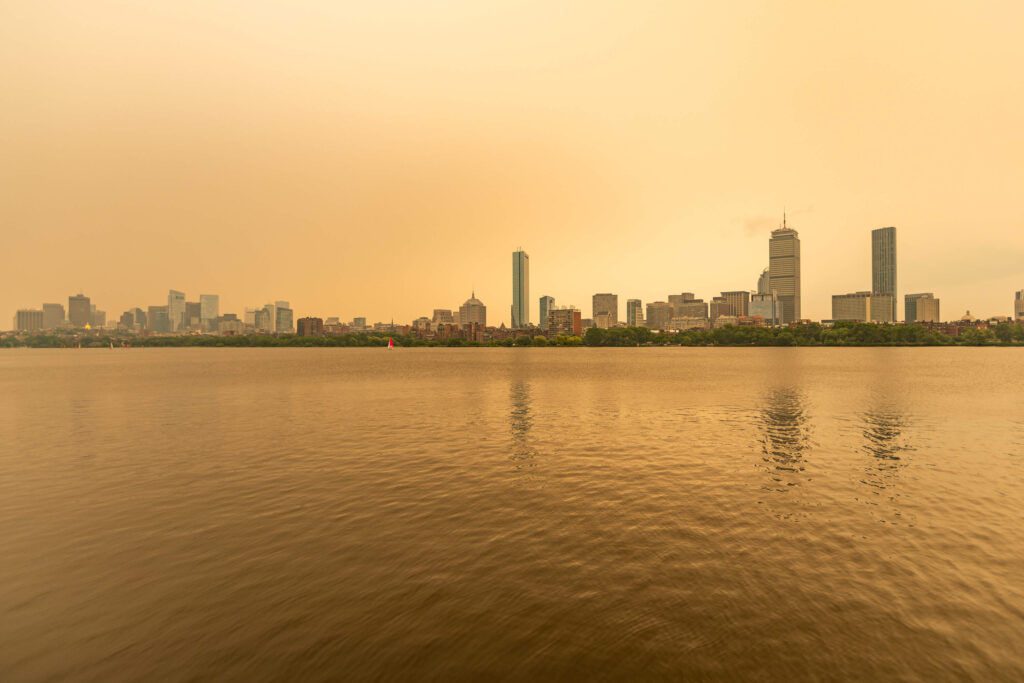
Why is the air quality bad today across so much of the United States? If the sky outside your window looks hazy, yellow, or unusually dim, the answer almost certainly traces back to Canada, where hundreds of wildfires are currently burning and sending thick smoke deep into American skies. According to the Canadian Interagency Forest Fire Centre, there are currently 836 active wildfires burning across the country, with 194 classified as completely out of control, concentrated heavily in the Northwest Territories, Ontario, and Quebec. That smoke has now triggered air quality alerts across at least 19 U.S. states, from the Great Lakes region through the Northeast, affecting tens of millions of people this week.
Which States Are Under Air Quality Alerts Right Now
The scale of this smoke event is unusually widespread. Air quality alerts have been issued across North Dakota, Minnesota, Michigan, Wisconsin, Illinois, Indiana, Ohio, Pennsylvania, West Virginia, Virginia, Kentucky, North Carolina, South Carolina, New Jersey, Delaware, Rhode Island, New York, Connecticut, Maryland, and Washington, D.C. Conditions have varied sharply by region: parts of Michigan reached “hazardous” air quality, the most severe classification on the AQI scale, while Wisconsin, Minnesota, Illinois, and Indiana experienced “very unhealthy” conditions. New York, New Jersey, Pennsylvania, Ohio, Connecticut, Rhode Island, Delaware, and Maryland have all reported “unhealthy” air alongside widespread visible haze.
Major landmarks across the affected region have become visual symbols of the smoke’s reach — the Statue of Liberty, the Washington Monument, the Chicago skyline, and Minnesota’s Cathedral of Saint Paul have all been photographed shrouded in an orange or gray haze over the past several days. In New York City specifically, conditions have fluctuated hour by hour: the Air Quality Index dropped to 68 (moderate) Friday evening as winds temporarily pushed smoke out of the area, only for forecasters to warn of a resurgence overnight into Saturday as a new plume moves back into the region. Meteorologists expect showers and storms to help flush the atmosphere clean by midday Saturday, though additional waves of smoke remain possible as Canada’s fire season continues.
Understanding What PM2.5 and AQI Numbers Actually Mean
The core health concern with wildfire smoke is a pollutant called PM2.5 — fine particulate matter so small it can be inhaled deep into the lungs and even enter the bloodstream. This is what turns the sky that distinctive orange or yellow color and what makes eyes sting or the air smell like a campfire even far from the actual fires. The Air Quality Index (AQI) translates PM2.5 and other pollutant concentrations into a single number, generally ranging from 0 to 500, with higher numbers indicating more dangerous conditions. An AQI above 100 is officially considered unhealthy for sensitive groups, and readings in the 150–200 range are classified as “unhealthy” for the general public.
For context on just how localized and fast-changing these numbers can be: during World Cup preparations in New Jersey this week, the area surrounding a training stadium recorded an AQI of 96 at 1 p.m. local time Friday — just below the unhealthy threshold — even as nearby areas registered far worse readings. Tournament organizers reportedly remained confident that Sunday’s World Cup final between Spain and Argentina would not be affected, but the episode illustrates how AQI can shift significantly within just a few miles depending on wind patterns and elevation.
Health Risks: Who Is Most Vulnerable Right Now
Health officials are especially concerned about sensitive groups, including children, older adults, pregnant women, and anyone with existing respiratory or cardiovascular conditions such as asthma, COPD, or heart disease. But wildfire smoke doesn’t spare healthy adults either — even people with no underlying conditions can experience coughing, shortness of breath, dizziness, fatigue, and eye or throat irritation when particulate levels climb this high.
Medical experts note that repeated or prolonged exposure to wildfire smoke can also aggravate existing chronic conditions, sometimes triggering symptoms in people who don’t typically experience respiratory issues. Because PM2.5 particles are small enough to bypass the body’s natural filtering mechanisms, doctors recommend limiting time outdoors entirely during “unhealthy” or worse air quality days, rather than simply reducing intensity of activity. Some public health officials have gone further, recommending that residents in the hardest-hit areas set up a designated “clean room” at home — a single space sealed off from outside air, ideally using a portable HEPA air purifier, where household members can gather if smoke conditions become severe enough to warrant staying indoors entirely.
Why This Is Happening: Inside Canada’s Wildfire Season
This isn’t an isolated event — it reflects a broader pattern that has repeated for several consecutive summers. Hot, dry weather combined with periods of strong wind and low humidity have sustained fire activity across Canada’s northern provinces and territories throughout the season. The Northwest Territories, Ontario, and Quebec currently hold the largest concentrations of active fires, and Canadian officials have acknowledged the country is once again experiencing one of its more severe wildfire seasons on record.
The political dimension of this recurring smoke event has also intensified this year. A group of Michigan Republican representatives — John James, Jack Bergman, John Moolenaar, and Lisa McClain — sent a public letter this week criticizing Canada’s government, arguing the country “has the tools to prevent” the smoke from crossing into the U.S. and “has chosen not to.” At least one member of Congress has gone so far as to call for economic sanctions tied to Canada’s wildfire management practices, reflecting growing frustration among lawmakers in states repeatedly affected by cross-border smoke, even though wildfire behavior is influenced heavily by weather conditions largely outside any government’s direct control.
How Long Will the Smoke and Poor Air Quality Last
Forecasters expect the current wave of unhealthy air to persist through the weekend, with some regional improvement possible as weather systems shift. In the Northeast specifically, meteorologists have pointed to showers and thunderstorms as the most likely mechanism for clearing the atmosphere, since rain helps settle particulate matter out of the air. However, because hundreds of fires remain active and new plumes have repeatedly formed throughout the week, residents in affected states should expect intermittent smoke waves rather than a single clean break, with air quality potentially fluctuating day to day or even hour to hour depending on wind direction.
Given how unpredictable this pattern has been — improving air quality reversing into new smoke arrivals within the same 24-hour period, as seen in New York City this week — checking real-time conditions rather than relying on yesterday’s forecast is especially important right now.
How to Check Your Local Air Quality and Stay Safe
The most reliable way to check current conditions is through AirNow.gov, the official U.S. government air quality monitoring site, which provides real-time, zip-code-level AQI data along with color-coded health guidance. The CDC’s wildfire smoke guidance also offers detailed recommendations for people with asthma, heart disease, or other conditions that make smoke exposure particularly risky.
Practical safety steps recommended by health officials include:
- Keep windows and doors closed, and run a high-quality HEPA air purifier indoors if you have one.
- Set vehicle ventilation to recirculate rather than pulling in outside air while driving through smoky conditions.
- Wear an N95 or P100 respirator if you must spend extended time outdoors — cloth or surgical masks do not effectively filter fine particulate matter.
- Limit strenuous outdoor activity, including exercise, for all age groups until local AQI drops back into the “moderate” or “good” range.
- Set up a clean room in your home if you or a family member is in a high-risk group and smoke is expected to persist for several days.
Is This Becoming the New Normal? Comparing Past Wildfire Seasons
For residents in the Midwest and Northeast, this week’s smoke may feel familiar — and that’s not a coincidence. Canada has now experienced several consecutive years of severe wildfire activity, with smoke-driven air quality alerts becoming a recurring feature of American summers rather than a rare event. Last year’s season produced similarly widespread alerts across Wisconsin, Michigan, Minnesota, Illinois, Indiana, New York, Vermont, New Hampshire, and Maine, with nearly 4,000 individual fires recorded by early August alone. The year before that, smoke from British Columbia and Alberta pushed AQI readings into unhealthy territory as far south as Nebraska and Kansas.
What differs this year is both the scale of the current outbreak — 836 active fires is a notably high count even by recent standards — and the breadth of the affected region, with alerts stretching from the northern Plains all the way to the mid-Atlantic and even Washington, D.C. Climate scientists have pointed to a pattern of hotter, drier summers and reduced snowpack in Canada’s northern provinces as contributing factors that extend fire seasons and make individual blazes harder to contain once they start. Whether or not any single season can be attributed directly to longer-term climate trends, the recurring nature of these cross-border smoke events suggests residents in frequently affected states may want to treat wildfire preparedness — stocking HEPA filters, keeping N95 masks on hand, and knowing how to set up a clean room — as a standard part of summer readiness rather than an occasional inconvenience.
Frequently Asked Questions
Why is the sky orange or yellow right now? Sunlight scattering through fine wildfire smoke particles filters out blue light and lets more red and orange wavelengths through, which is what gives the sky its unusual color during heavy smoke events.
Is it safe to exercise outside today? Health officials recommend avoiding strenuous outdoor exercise whenever AQI reaches the “unhealthy for sensitive groups” level or higher, since increased breathing rates pull more particulate matter deep into the lungs.
How long will Canadian wildfire smoke keep affecting the US? With hundreds of fires still active and dozens classified as out of control, intermittent smoke events are likely to continue through the remainder of the summer wildfire season, though individual smoke waves typically clear within a few days as weather patterns shift.
Do regular cloth masks protect against wildfire smoke? No. Only respirators rated N95 or P100 are effective at filtering the fine PM2.5 particles found in wildfire smoke; standard cloth or surgical masks do not provide meaningful protection.
Do air purifiers actually help during wildfire smoke events? Yes, portable HEPA air purifiers are effective at removing fine particulate matter from indoor air, and running one in a sealed “clean room” is one of the most reliable ways to reduce indoor smoke exposure when outdoor air quality reaches unhealthy levels.
This article reflects air quality conditions and reporting as of July 18, 2026. Conditions are changing rapidly — check AirNow.gov for real-time updates in your area.els Mean for You
High AQI levels mean that sensitive groups—including children, the elderly, and those with respiratory conditions—should take extra precautions. Even healthy adults may experience irritation or fatigue when smoke is this thick. It is highly recommended to keep windows closed, use high-quality air filters (HEPA) indoors, and limit strenuous outdoor activities until conditions improve.
How to Stay Safe
- Monitor Local Reports: Keep an eye on real-time AQI updates for your specific zip code.
- Recirculate Air: If driving, set your car’s ventilation to recirculate to avoid pulling in smoky air.
- Mask Up: If you must spend extended time outside, an N95 or P100 respirator can help filter out fine particles.